
European countries explore 3D printing buildings
2022-07-20
Not long ago, Spain's first earthen 3D printed house was unveiled on the outskirts of Barcelona. The building was constructed by the Higher School of Architecture in Catalonia, Spain, and an Italian manufacturer of 3D architectural printers. The house was designed according to the local climate to more effectively withstand the cold in winter and the scorching sun in summer. Experts said that using local raw materials to manufacture printing mortar can effectively reduce construction costs and further create conditions for the promotion of 3D printing construction technology in the future.
In recent years, many European countries have accelerated the exploration and development of 3D printing buildings. The city government of Eindhoven, the Netherlands, launched the "Milestone Project" project, which plans to build and form a public housing community built by 3D printing. Last year, the first house of the project welcomed tenants. According to reports, it took less than five days to build the 94-square-meter house. Germany, Austria, Denmark and other countries have also launched 3D printed buildings such as small office buildings and low-rise residential buildings.
3D printing construction technology is essentially an additive manufacturing process. The designer inputs the digital design model into the construction printer and converts it into printing instructions, and the machine will superimpose the special materials layer by layer into building parts of a specific shape according to the design requirements. . 3D printing buildings have obvious advantages in terms of efficiency improvement and sustainable development.
According to the statistics of Saint-Gobain Group, a well-known French construction company, 3D printing technology can save about 60% of labor time and 80% of labor for enterprises. Through 3D printing technology, the structure optimization of the construction process can also be achieved, the generation of construction waste can be effectively controlled, and the impact on the environment can be reduced. Designers can also use 3D printing technology to realize more complex design concepts, which can help the architectural design to be more creative.
The 3D printing construction market has huge potential. According to the United Nations Human Settlements Programme (UN-Habitat), by 2030, about 3 billion people around the world will need to improve their housing environment, which means that 96,000 new housing units will be built around the world every day. Facing the huge market demand, there is an urgent need for a construction model with lower cost, higher construction efficiency and stronger safety. According to reports from professional institutions, the global 3D printing construction market will reach US$521 million by 2027, with a compound annual growth rate of nearly 25%. Grace Alice, an expert in the field of European digital construction, said that 3D printing construction technology is developing at a rapid pace, which will drive automation and digitization in the construction field, and provide solutions to the current global problems of housing shortage and labor shortage.
At present, 3D printing construction technology is still in its infancy, and there are still many challenges to achieve large-scale development. For example, the compliance issues of 3D printing buildings still follow traditional building standards, and there is still a lack of unified international standards. Recently, the 3D printed house built by the German Perry Construction Company passed the comprehensive certification of the German national building standard for the first time. The industry believes that this progress will have a positive impact on the large-scale promotion of 3D printed buildings in the future. Fabian Brentz, head of the company's 3D printing construction department, said that in the future, 3D printing buildings will develop in the direction of multi-family residential communities, and truly solve the problem of large-scale development.
Henrik Nielsen, founder of COBOD, a well-known 3D construction printer manufacturer in Denmark, believes that with the further development and maturity of technology, the cost of 3D printing buildings will drop significantly, driving revolutionary changes in the entire construction industry. Huysman, CEO of Weber Construction Company of the Netherlands, said that 3D printing construction will provide a new construction method and business model, and industry practitioners including project contractors, technicians, circuit workers, etc. Skill training is also an important factor for the future marketization of 3D printed buildings.
In recent years, many European countries have accelerated the exploration and development of 3D printing buildings. The city government of Eindhoven, the Netherlands, launched the "Milestone Project" project, which plans to build and form a public housing community built by 3D printing. Last year, the first house of the project welcomed tenants. According to reports, it took less than five days to build the 94-square-meter house. Germany, Austria, Denmark and other countries have also launched 3D printed buildings such as small office buildings and low-rise residential buildings.
3D printing construction technology is essentially an additive manufacturing process. The designer inputs the digital design model into the construction printer and converts it into printing instructions, and the machine will superimpose the special materials layer by layer into building parts of a specific shape according to the design requirements. . 3D printing buildings have obvious advantages in terms of efficiency improvement and sustainable development.
According to the statistics of Saint-Gobain Group, a well-known French construction company, 3D printing technology can save about 60% of labor time and 80% of labor for enterprises. Through 3D printing technology, the structure optimization of the construction process can also be achieved, the generation of construction waste can be effectively controlled, and the impact on the environment can be reduced. Designers can also use 3D printing technology to realize more complex design concepts, which can help the architectural design to be more creative.
The 3D printing construction market has huge potential. According to the United Nations Human Settlements Programme (UN-Habitat), by 2030, about 3 billion people around the world will need to improve their housing environment, which means that 96,000 new housing units will be built around the world every day. Facing the huge market demand, there is an urgent need for a construction model with lower cost, higher construction efficiency and stronger safety. According to reports from professional institutions, the global 3D printing construction market will reach US$521 million by 2027, with a compound annual growth rate of nearly 25%. Grace Alice, an expert in the field of European digital construction, said that 3D printing construction technology is developing at a rapid pace, which will drive automation and digitization in the construction field, and provide solutions to the current global problems of housing shortage and labor shortage.
At present, 3D printing construction technology is still in its infancy, and there are still many challenges to achieve large-scale development. For example, the compliance issues of 3D printing buildings still follow traditional building standards, and there is still a lack of unified international standards. Recently, the 3D printed house built by the German Perry Construction Company passed the comprehensive certification of the German national building standard for the first time. The industry believes that this progress will have a positive impact on the large-scale promotion of 3D printed buildings in the future. Fabian Brentz, head of the company's 3D printing construction department, said that in the future, 3D printing buildings will develop in the direction of multi-family residential communities, and truly solve the problem of large-scale development.
Henrik Nielsen, founder of COBOD, a well-known 3D construction printer manufacturer in Denmark, believes that with the further development and maturity of technology, the cost of 3D printing buildings will drop significantly, driving revolutionary changes in the entire construction industry. Huysman, CEO of Weber Construction Company of the Netherlands, said that 3D printing construction will provide a new construction method and business model, and industry practitioners including project contractors, technicians, circuit workers, etc. Skill training is also an important factor for the future marketization of 3D printed buildings.
Related Articles
 "3D Printing Material Technology and Market - 2022 Edition" 2022-07-20 209
- Xinjiang Dashixia: 3D technology "prints" a smart dam-Guangzhou International 3D Printing Exhibition 2022-07-20 220
- 3D printing: the old area has a "technical style" - Guangzhou 3D Printing Exhibition 2022-07-20 192
- Zhuhai Xitong's new role leads the trend of domestic 3D printing 2022-07-20 217
- Follow Shanghai Inside3D Printing Exhibition to explore the trend of 3D printing in China 2022-07-20 230
- Where is the road for 3D printing? Look at the 3D printing market from Inside 3D 2022-07-20 198
- 3D anecdote Zhou Zhoukan Sound waves can also create 3D printed objects? 2022-07-20 261
- You are the most beautiful among the flowers, the best inventory of 3D printing in CES Asia 2022-07-20 198
- The truth is worth digging. How accurate is the desktop FDM 3D printer? 2022-07-20 263
- Nobel Laureate in Chemistry Daniel Shetman: 3D printing will become a rolling technology 2022-07-19 233
- Printing in 7 seconds for rapid drug production 2022-07-19 267
- Desktop Metal officially launches a new large-scale 3D printing system 2022-07-19 245
- What does the additive design software with fool-like operation and automatic lattice generation look like? 2022-07-19 257
- Light-curing 3D printing materials measured! The performance of Qingfeng elastic and tough materials in pillows | cushions | industrial products is unconventional 2022-07-19 279
- Explore how to achieve more targeted nutritional food through 3D printing 2022-07-19 235
- The RAF is developing a swarm of 3D-printed drones 2022-07-19 290
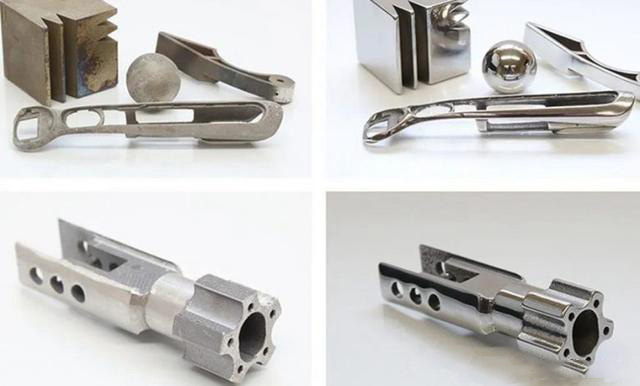 Common post-processing methods for metal 3D printed parts 2022-05-18 345
 On September 9, 2021, the first Shenzhen Formnext + PM South China was held in Shenzhen International Convention and Exhibition Center. At the exhibition site, Antarctic Bear saw Dongguan Dyewin 2021-09-11 326
 Domestic automatic 3D printing post-processing system, Dongguan Dyewin coloring technology breaks many domestic blanks 2019-10-21 401
 Post-processing for 3D printing: cleaning, annealing, coloring 2022-11-28 214
